

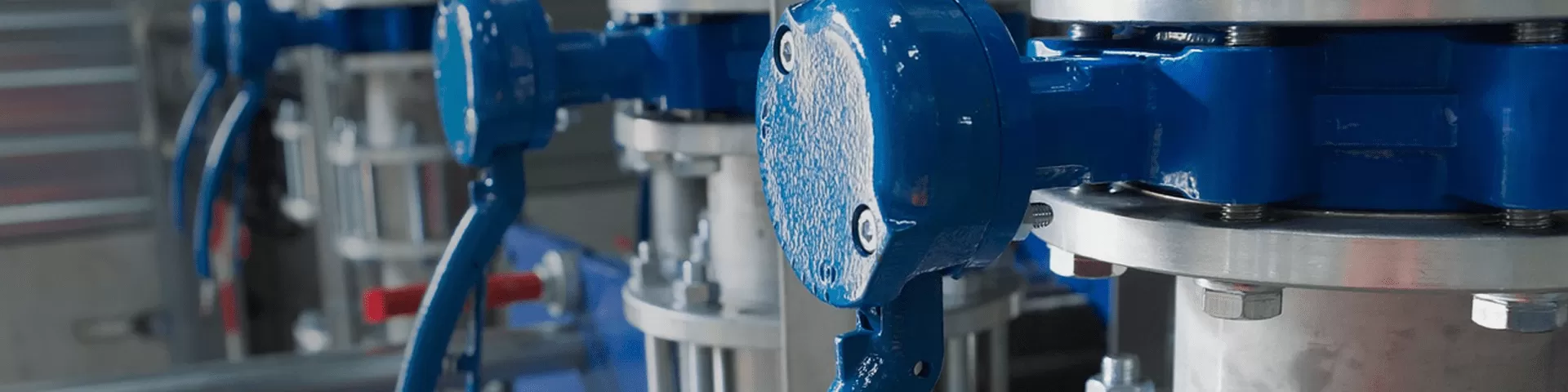
Published by: CNLD VALVE (ZHEJIANG LED VALVE CO.,LTD) – Technical Blog
Have you ever heard a sharp, screeching noise from a valve, felt strong vibrations in the pipeline, and later found pitting, honeycomb-like erosion, or even perforation on the internal parts?
That is cavitation.
Many engineers mistake it for chemical corrosion or abrasive wear. They replace the valve with the same model – sometimes using more expensive alloys – only to see the damage return within weeks.
The truth is: cavitation is not a material problem. It is a physical fluid phenomenon. Understand how and why it happens, and you can eliminate or significantly suppress it at the source.
What Exactly Is Valve Cavitation?
Cavitation occurs when liquid flows through a valve’s throttling zone – typically the seat and plug. The flow velocity increases sharply, and the local pressure drops dramatically. When this pressure falls below the liquid’s vapor pressure at the given temperature, the liquid vaporizes into tiny vapor bubbles.
These bubbles are carried downstream. When they reach a zone with higher pressure, they collapse – or implode – almost instantly. This collapse generates extremely high local impact forces, theoretically up to several thousand atmospheres, along with powerful micro‑jets that repeatedly strike the valve’s internal surfaces.
Over time, this hammering creates surface fatigue, pitting, and eventually deep craters, leakage, and valve failure. At the same time, cavitation produces characteristic noise (like gravel flowing through the pipe) and strong vibration.
Cavitation vs. Corrosion – A Critical Difference
Cavitation is a physical impact phenomenon, while corrosion is a chemical or electrochemical reaction caused by the medium reacting with the valve material. Their appearances are different too: cavitation creates localized pits, craters or a honeycomb pattern, whereas corrosion usually shows uniform or localized rust, discoloration, or general material loss.
Because their causes are completely different, the solutions are different as well. If you mistake cavitation for corrosion and simply upgrade to a more corrosion‑resistant alloy, the cavitation damage will continue – and you will waste money. That said, in real services cavitation can remove protective surface layers and expose fresh metal, which may accelerate chemical corrosion. The two often work together, so you need to consider both possibilities.
How to Recognize Cavitation – Three Signs
First, you hear a sharp noise and feel strong vibration during operation – this is not normal flow sound. Second, when you open the valve, you see pitting or honeycomb‑like erosion on internal parts, not uniform rust. Third, the damage is concentrated at the throttling area – for example, the valve plug, seat, or cage.
What Causes Cavitation?
Two basic conditions must exist for cavitation to happen: an excessive pressure drop across the valve, and a high flow velocity that pulls local pressure below vapor pressure.
Based on field experience, four common triggers are:
Wrong valve type. Using a valve with very small throttling gaps – such as an ordinary globe valve – in a high differential pressure application.
Chronically low opening. Operating a single‑seat or globe valve at 10–20% open for long periods makes the throttling effect much worse.
Unfavorable process conditions. High fluid temperature raises the vapor pressure, making cavitation easier to occur. Excessively high flow rate also contributes.
Poor internal trim design. No pressure‑reducing or flow‑guiding features inside the valve cause vortices and localized pressure drops.
How to Solve Cavitation – Practical Methods
You do not always need complex system modifications. Focus on three directions: reduce pressure drop, slow down velocity, and optimize valve internals.
For applications with high differential pressure – for example, pressure reduction in high‑pressure lines – avoid ordinary globe valves or standard ball valves. Instead, choose multi‑stage pressure reducing valves such as multi‑hole cage valves, labyrinth‑type control valves, or anti‑cavitation trim valves. These designs distribute the total pressure drop over several small steps, keeping the local pressure above vapor pressure.
A helpful tip: during valve selection, calculate the cavitation index (σ) to ensure compatibility with your actual pressure differential and flow rate. At CNLD VALVE (ZHEJIANG LED VALVE), we help customers select the right anti‑cavitation trim based on their specific media, pressure, and temperature conditions.
Avoid prolonged low opening for ordinary single‑seat or globe valves. Keep the opening between 30% and 80% whenever possible. If the process allows, reduce fluid temperature – a lower temperature means lower vapor pressure and fewer bubbles. Also, if the pressure drop across a single valve is too large, install a pressure‑reducing valve upstream to split the total drop into two stages, avoiding a sudden pressure drop across one valve.
For valves that already show minor cavitation, you can replace standard internals with cavitation‑resistant trim made of hardened materials, such as Stellite‑faced plugs or tungsten carbide coatings. Please note that this extends service life but does not prevent bubble formation itself. Regular inspections are essential – check for pitting or wear and repair or replace damaged parts early. Also keep the valve clean, because debris inside can disturb flow and increase local pressure fluctuations, making cavitation worse.
Final Thoughts
Valve cavitation is not an unsolvable mystery. It is a predictable and preventable physical phenomenon. The key is to control pressure drop and flow velocity so that the local pressure never falls below the vapor pressure of the liquid.
If you are facing repeated cavitation damage, do not simply buy a valve of the same type. Start by analyzing your pressure differential, operating opening, and fluid temperature. Then select the right valve design – such as multi‑stage or anti‑cavitation trims – and adjust your operating practices.
At CNLD VALVE (ZHEJIANG LED VALVE), we offer a full range of anti‑cavitation valves, including multi‑stage cage valves, labyrinth trim valves, and hardened trim options. Our engineering team can help you diagnose cavitation issues and propose cost‑effective solutions that address the root cause – not just the symptoms.
For more technical insights, stay tuned to our blog or contact our support team with your specific operating parameters.